

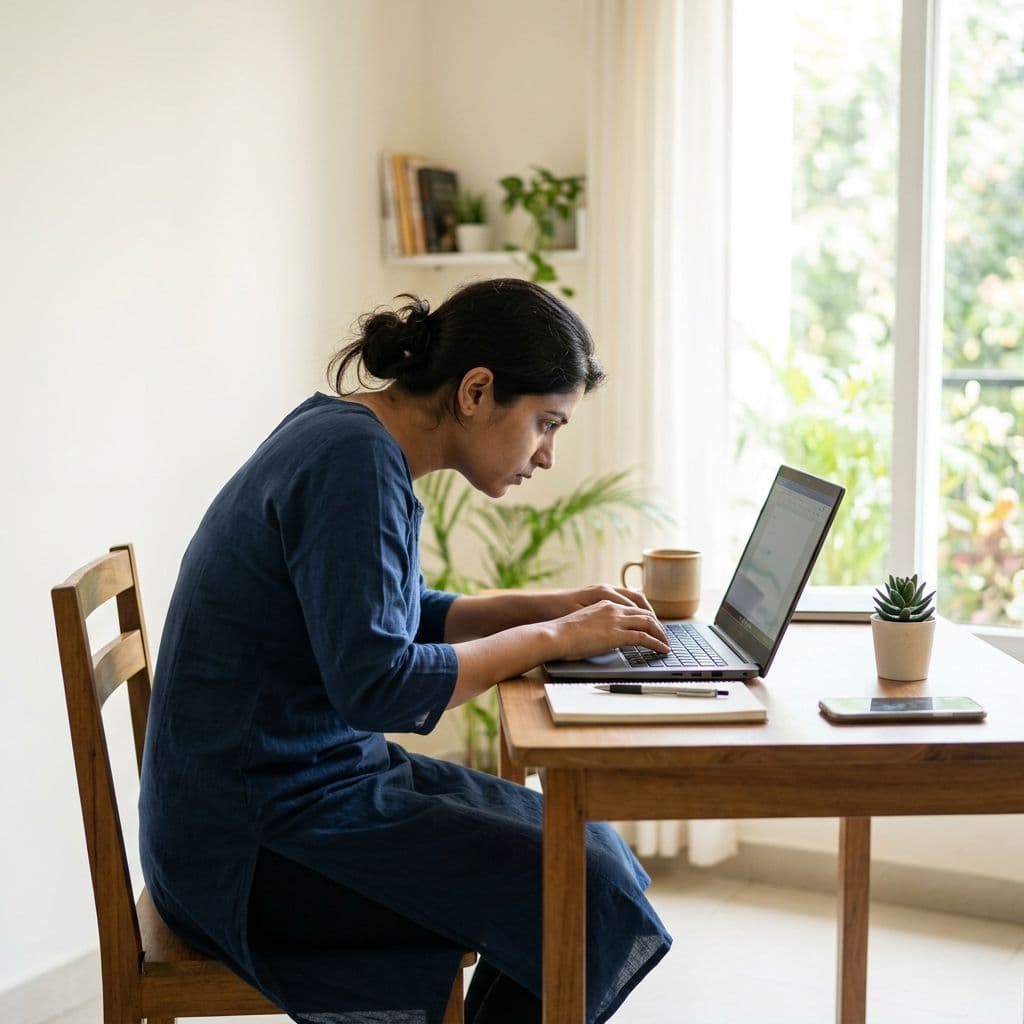
Why hours at a laptop turn into a stiff, aching neck
Laptops are compact by design, and that's exactly the problem for your neck. The screen and keyboard are fixed to each other, so getting the keyboard at a comfortable height almost always means looking down at a screen positioned too low. Do that for six or eight hours a day, and the neck spends most of its time in a forward-flexed position it was never meant to hold for long.
What's actually happening in the neck
Looking down at a laptop screen increases the effective load on the neck significantly compared to a neutral, upright head position, since the head tilts forward and gravity pulls it further down the more it drops. The muscles at the back of the neck and upper back have to work continuously to stop the head from dropping further, which is why the pain is so often felt in the same specific spot: the base of the skull and across the top of the shoulders.
Held long enough, this pattern leads to a few predictable changes: the deep neck flexor muscles at the front weaken from disuse, the upper trapezius and neck extensor muscles become chronically overworked and tight, and the joints in the upper neck stiffen from staying in one shortened position for hours at a stretch. This combination is what produces the classic tight, achy, "stuck" feeling by the end of a workday.
Why stretching alone doesn't fully fix it
Stretching the tight muscles gives temporary relief, which is why it feels good in the moment, but the tightness usually returns by the next afternoon. That's because stretching addresses the muscles working overtime, not the underlying reason they're overworking in the first place: a weak deep neck flexor system and a screen position that keeps demanding a forward head posture.
What actually helps
Fix the screen height, not just your posture. Raising the laptop screen to eye level, using a stand or a stack of books along with an external keyboard, removes a large part of the postural demand rather than asking your neck muscles to fight gravity all day through willpower alone.
Strengthen the deep neck flexors. Simple chin tuck exercises, done correctly and consistently, retrain the muscles that should be supporting head position, taking some of the load off the overworked muscles at the back of the neck.
Address upper back mobility, not just the neck. A stiff upper back (thoracic spine) often forces the neck to compensate with extra forward posture. Improving upper back mobility frequently reduces neck strain more than working on the neck alone.
Take real movement breaks. Even a good posture becomes a bad posture if held for three hours straight. Brief position changes every 30-45 minutes prevent the same tissues from being loaded continuously all day.
A simple workstation checklist worth actually following
Most of this comes down to a handful of adjustments that are easy to describe but easy to skip in practice. The top of the screen should sit roughly at eye level, which usually means a laptop stand or a stack of books plus a separate keyboard and mouse. Elbows should rest close to your sides at roughly a right angle rather than reaching forward. Feet should be flat on the floor or a footrest, not dangling or tucked under the chair. And the chair itself should support the lower back's natural curve, since a slumped lower back almost always drags the neck forward to compensate. None of these fixes are dramatic on their own, but stacked together they remove a large share of the postural demand that builds into daily neck pain.
When it's more than "just work stress"
If neck pain from laptop use is accompanied by tingling or numbness into the arm or hand, or headaches that start at the back of the head and wrap forward, it's worth getting a proper musculoskeletal physiotherapy assessment rather than just adjusting your desk setup, since these can point to nerve involvement or joint-specific issues that need targeted treatment.
If your neck pain has become a daily pattern rather than an occasional ache, book an assessment at Physynex in Purasaiwakkam, Chennai, or call +91 92117 36580.