

Tingling in the hand is easy to ignore at first. It may come and go at night, appear after typing, show up while holding a phone, or make the hand feel clumsy during small tasks. But when tingling, numbness, burning, or weakness keeps returning, it is worth finding out which nerve is involved. Two common upper-limb nerve compression problems are carpal tunnel syndrome and cubital tunnel syndrome.
They sound similar, but they are not the same. Carpal tunnel syndrome involves the median nerve at the wrist. Cubital tunnel syndrome involves the ulnar nerve at the elbow. The affected fingers, triggers, and treatment strategy can be different.
What nerve pain feels like
Nerve symptoms often feel different from joint or muscle pain. People may describe:
- Tingling
- Pins and needles
- Burning
- Electric shocks
Also note: Numbness; Weak grip; Dropping objects; Clumsiness with buttons, keys, or typing.
The distribution matters. Which fingers are affected can tell us a lot.
Carpal tunnel syndrome: the wrist pattern
Carpal tunnel syndrome happens when the median nerve is compressed or irritated at the wrist. Symptoms often affect the thumb, index finger, middle finger, and part of the ring finger.
Common signs include:
- Night-time tingling or numbness
- Shaking the hand for relief
- Symptoms with gripping, typing, driving, or phone use
- Weak pinch grip
- A swollen feeling in the fingers even when swelling is not obvious
Common contributors include repetitive gripping, prolonged wrist bending, pregnancy-related fluid changes, diabetes, inflammatory conditions, and tool or keyboard demands.
Cubital tunnel syndrome: the elbow pattern
Cubital tunnel syndrome involves the ulnar nerve at the elbow. Symptoms often affect the ring and little fingers.
Common signs include:
- Tingling in the ring and little finger
- Symptoms when the elbow is bent for a long time
- Pain or sensitivity along the inner elbow
- Worse symptoms when leaning on the elbow
- Grip fatigue or fine motor difficulty
Common contributors include prolonged elbow bending, leaning on armrests, sleeping with the elbow flexed, repetitive elbow loading, and previous elbow injury.
Quick finger map
Use this simple guide:
- Thumb, index, middle: think median nerve and carpal tunnel pattern.
- Ring and little finger: think ulnar nerve and cubital tunnel pattern.
- Whole arm symptoms with neck pain: the neck may also need assessment.
This is not a diagnosis, but it helps direct the evaluation.
Self-check questions
Ask:
- Which fingers tingle?
- Do symptoms wake you at night?
- Does wrist bending make it worse?
- Does elbow bending make it worse?
Also note: Do you lean on your elbows while working?; Are you dropping objects or losing grip strength?; Is there neck pain with arm symptoms?.
The answers help decide whether the wrist, elbow, neck, or a combination is involved.
What physiotherapy can do
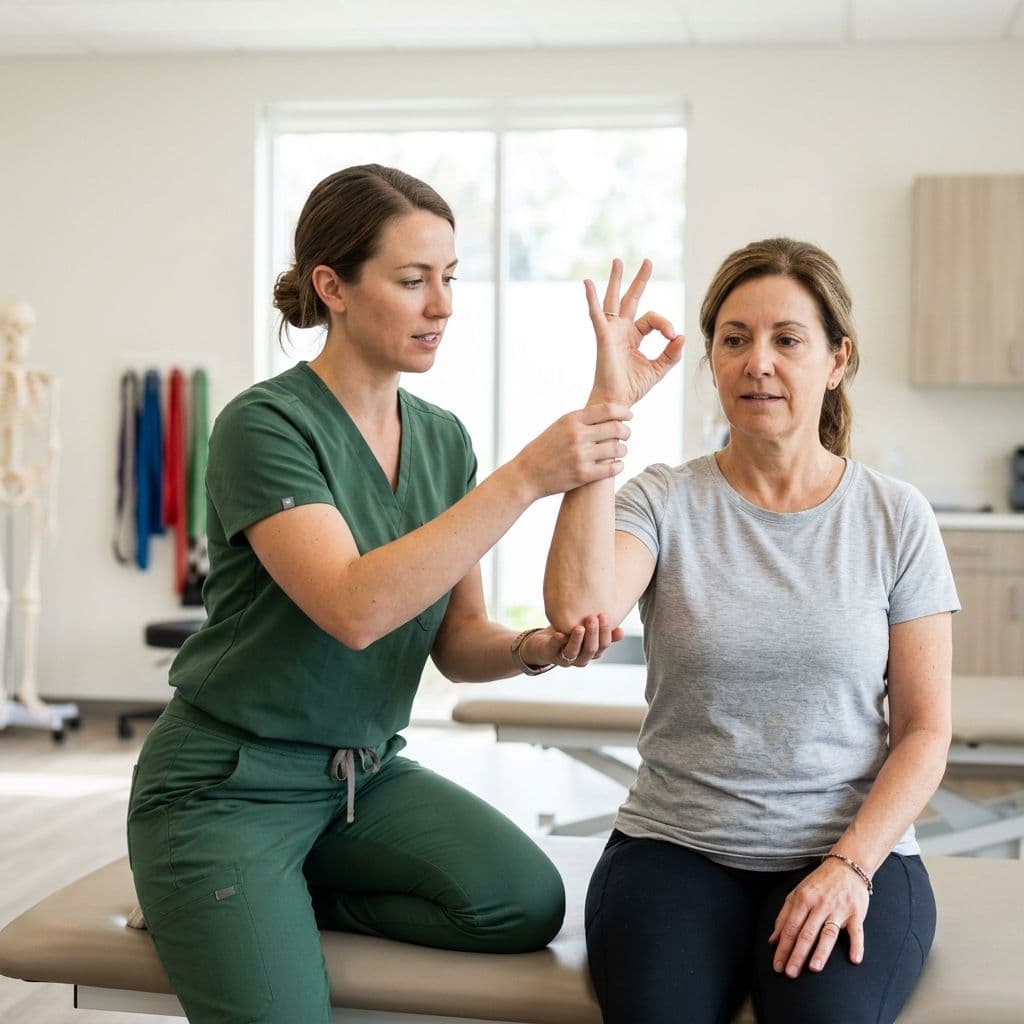
Activity modification: We identify the positions that compress the nerve and reduce repeated irritation. That may include changing wrist position, avoiding prolonged elbow flexion, adjusting desk setup, or modifying tool use.
Splinting guidance: Some people with carpal tunnel symptoms benefit from a neutral wrist splint at night. Some with cubital tunnel symptoms need strategies to avoid sleeping with the elbow fully bent. Splinting should match the nerve and symptom pattern.
Nerve-sensitive movement: Nerve gliding or mobility exercises may be useful when chosen correctly. They should not create lasting tingling or worsening numbness.
Strength and control: Shoulder, forearm, wrist, and hand strength can support recovery once symptoms are controlled.
Neck and posture assessment: Not all hand tingling starts at the wrist or elbow. The neck and shoulder region may influence nerve sensitivity.
What to try first
General starting points include:
- Avoid sleeping with wrists or elbows curled tightly.
- Take short breaks from repeated gripping or typing.
- Keep wrists closer to neutral during keyboard or phone use.
- Avoid leaning directly on the inner elbow.
Also note: Notice whether symptoms settle when position changes.; Track which fingers are affected..
If numbness is constant or weakness is progressing, do not wait.
Workstation and sleep changes that matter
For carpal tunnel symptoms, wrist position often matters at night and during gripping tasks. A neutral wrist position may reduce irritation. For cubital tunnel symptoms, elbow position is often the bigger issue. Sleeping with the elbow fully bent or leaning on the inner elbow during work can keep symptoms active.
Try observing:
- Is the wrist bent while sleeping?
- Is the elbow bent under the pillow?
- Do you lean on the elbow while using a laptop?
- Do you grip the phone tightly for long periods?
Also note: Does driving reproduce symptoms?; Does typing posture change symptoms?.
The goal is not perfect posture. It is reducing repeated compression long enough for the nerve to calm.
How physiotherapy progression works
Early care often focuses on reducing irritation. Later care focuses on rebuilding capacity. A complete plan may include:
- Symptom mapping by finger distribution
- Neck, shoulder, elbow, wrist, and hand screening
- Grip and pinch strength testing
- Sensory testing
Also note: Activity modification; Splinting advice where appropriate; Nerve and tendon gliding if tolerated; Forearm, shoulder, and hand strengthening; Return-to-work or return-to-training planning.
If symptoms improve with position changes, that is useful information. If symptoms continue despite good modification, medical review or nerve testing may be needed.
How to know it is improving
Look for:
- Fewer night symptoms
- Less frequent tingling
- Better grip endurance
- Less need to shake the hand
Also note: More predictable triggers; Improved fine motor tasks.
Do not judge progress only by one bad day. Nerve symptoms can fluctuate, but the overall pattern should gradually improve.
When symptoms may involve the neck
Hand tingling is not always only a wrist or elbow problem. If symptoms come with neck pain, shoulder blade pain, arm heaviness, or changes when you move the neck, the cervical spine should be assessed. Nerves travel from the neck into the arm, so irritation can occur at more than one point.
This is sometimes called a double-crush pattern, where the nerve is sensitive in more than one region. For example, a person may have mild neck-related nerve sensitivity and also compress the wrist during sleep. Treating only the wrist may help partially but not fully.
Practical daily changes
Try these for one week:
- Keep the wrist neutral during sleep if thumb-side symptoms dominate.
- Avoid leaning on the inner elbow if ring and little finger symptoms dominate.
- Change phone grip regularly.
- Take micro-breaks from typing or tools.
Also note: Keep shoulders relaxed rather than shrugged.; Track whether symptoms reduce in frequency..
If these changes make a clear difference, they provide useful clues for treatment.
Red flags
Seek medical review if:
- Weakness is worsening
- Numbness is constant
- The hand muscles are visibly wasting
- Symptoms followed trauma
- Pain is severe and spreading
- There is significant neck pain with arm weakness
These signs may need nerve testing, medical treatment, or faster specialist review.
Common questions about hand and arm nerve pain
Are carpal tunnel and cubital tunnel the same?
No. Carpal tunnel affects the median nerve at the wrist. Cubital tunnel affects the ulnar nerve at the elbow.
Can physiotherapy help?
Yes, especially in mild to moderate cases where symptoms are position-related and strength is not rapidly worsening.
Do I need surgery?
Not always. Many cases are managed with activity changes, splinting, exercises, and medical care. Severe or progressive cases may need specialist treatment.
Should I stop typing?
Usually not completely. The better approach is to change position, take breaks, reduce aggravating volume, and address the nerve sensitivity.
When hand tingling needs assessment
Book an assessment if tingling wakes you at night, numbness is becoming more frequent, grip feels weaker, or you are unsure whether the symptoms are coming from the wrist, elbow, or neck. Early assessment is useful because nerve symptoms often respond better before weakness becomes established.
The assessment should map the exact fingers involved, test strength and sensation, check wrist and elbow positions, screen the neck, and identify work or sleep habits that compress the nerve. The plan may be simple, but it needs to be specific. Median nerve symptoms and ulnar nerve symptoms should not be managed as if they are identical.
Bring details about your work setup, sleep position, phone use, driving, and any tool use. Nerve irritation often hides in repeated daily positions, so small habit details can change the treatment plan.
Explore hand and nerve care
Clinic takeaway for nerve symptoms
If your hand is tingling, going numb, or losing strength, do not guess which tunnel is involved. At Physynex, we map the symptoms, test the nerve pattern, check the neck and upper limb, and build a plan that protects the nerve while keeping your hand useful.