
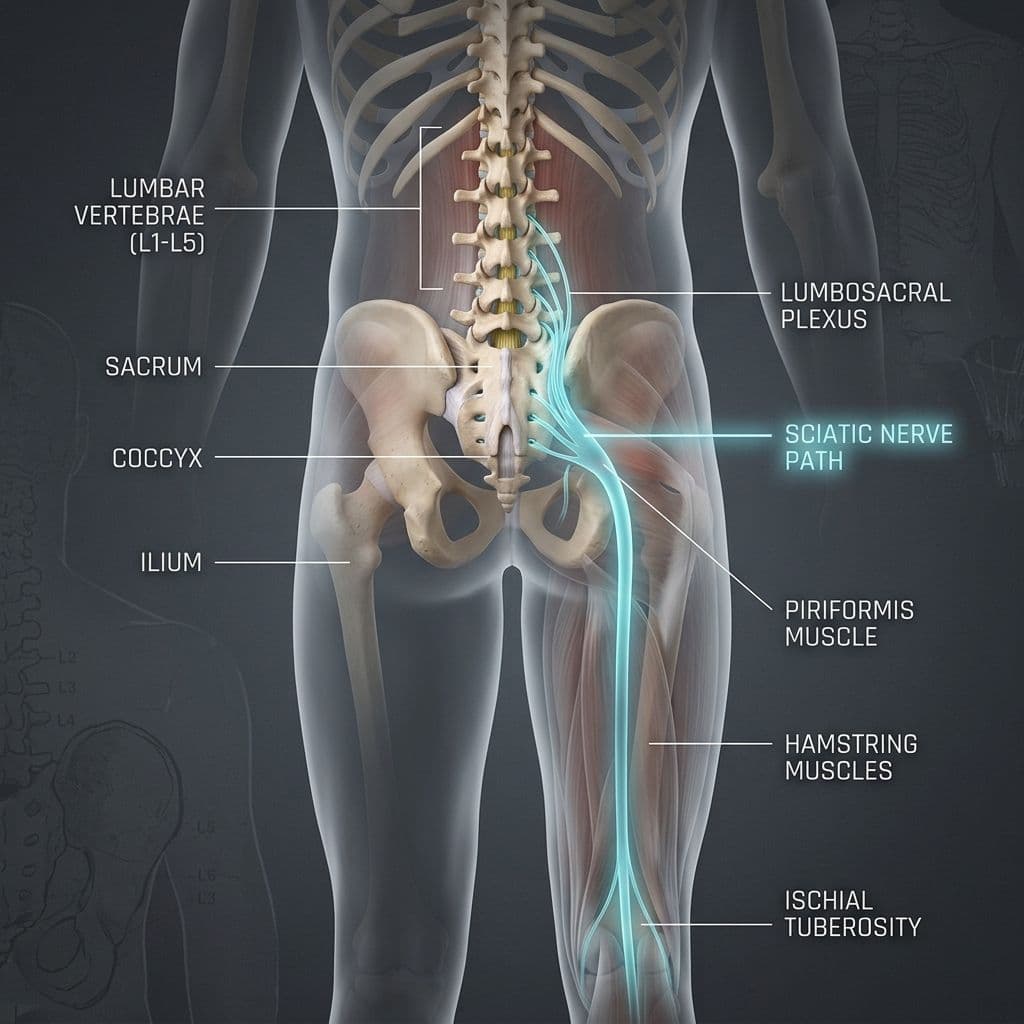
People often use the word sciatica for any pain that reaches the buttock or leg. Clinically, sciatica usually refers to symptoms related to irritation or compression of a nerve root in the lower spine. The pattern may include leg pain, tingling, numbness, altered sensation, or weakness, sometimes with surprisingly little back pain.
Mechanical lower back pain is more commonly centred around the lumbar region and may spread into the buttock or upper thigh without clear neurological features. The distinction is not always obvious from location alone. A detailed history and examination are more useful than a symptom diagram found online.
Both conditions often improve with non-surgical care, but the assessment priorities differ. Sciatica requires careful neurological monitoring, while severe or rapidly changing symptoms can require urgent medical attention.
Features that are more consistent with sciatica
Sciatic symptoms often follow a line down one leg and may travel below the knee. Coughing, sneezing, sitting, bending, or particular spinal movements can change the pain. Some people describe electric, burning, shooting, or pulling sensations, although pain quality alone cannot confirm a diagnosis.
Neurological symptoms are particularly important. Numbness in a consistent area, weakness in ankle or toe movement, altered reflexes, or reduced calf strength may support nerve-root involvement. Symptoms should be documented so changes can be recognised over time.
- Leg pain that is more prominent than back pain
- Tingling, numbness, or altered sensation in part of the leg or foot
- Weakness during heel walking, toe walking, or specific movements
- Symptoms affected by coughing, sneezing, sitting, or spinal position
- A pattern that follows one side more clearly than general aching
Features more typical of mechanical lower back pain
Mechanical back pain usually changes with movement, position, or load and remains primarily in the back. It may feel stiff after sitting, sore with repeated bending, or tired after lifting. Pain can refer into the buttock without indicating nerve damage.
This category still contains several possible contributors, including joint irritation, muscle strain, reduced tolerance after inactivity, and persistent pain sensitivity. A clinician should avoid claiming certainty from one movement or one tender point.
- Pain centred in the lower back with or without buttock discomfort
- Symptoms linked to bending, lifting, prolonged sitting, or standing
- No consistent numbness, tingling, or neurological weakness
- Improvement with movement, position change, or temporary load reduction
- Recurring episodes associated with workload or activity changes
How physiotherapists assess back and leg symptoms
The history should clarify where symptoms travel, whether numbness or weakness is present, how walking is affected, and whether bladder, bowel, sexual, or saddle-area changes have occurred. Medical history, recent infection, trauma, cancer history, medication, and systemic symptoms are also relevant.
The examination may include spinal movement, repeated-movement testing, leg strength, reflexes, sensation, walking, calf raises, and neural provocation tests. Findings are considered together. One positive test does not prove a disc problem, and one normal test does not override a concerning history.
- Map pain and altered sensation rather than using the word sciatica alone
- Compare key muscle strength between sides
- Check reflexes and sensation when clinically indicated
- Observe walking, balance, heel raises, and functional movements
- Reassess neurological findings if symptoms change
Treatment principles for sciatica and back pain
Treatment is guided by irritability and function. Some people tolerate walking and gentle repeated movements early; others need shorter bouts and more frequent position changes. Prolonged bed rest is generally unhelpful because it reduces conditioning and can increase fear of movement.
As symptoms settle, rehabilitation expands to trunk, hip, and leg strength, lifting, and the activities that have been avoided. Education matters: nerve pain can be intense without automatically meaning permanent nerve damage. At the same time, progressive weakness should never be dismissed as a normal flare.
- Find positions and movements that reduce or centralise symptoms
- Maintain tolerable walking and daily activity
- Use graded strengthening once the acute irritability allows
- Modify sitting, driving, and lifting temporarily
- Escalate care when neurological function worsens
When scans or specialist opinions may be useful
Routine imaging is not required for every person with back or leg pain. It becomes more relevant when serious pathology is suspected, neurological loss is progressive, symptoms remain highly disabling despite appropriate care, or the result is likely to guide an intervention.
A scan should be interpreted alongside the examination. Disc bulges and degenerative changes can exist without symptoms. The purpose of imaging is to answer a clinical question, not simply to prove that pain is real.
What to monitor during recovery
Monitor function as carefully as pain. Walking distance, sleep, sitting tolerance, leg strength, and the distribution of symptoms are meaningful. Pain moving out of the foot and becoming more local may be encouraging in some presentations, but every pattern must be interpreted clinically.
Keep a simple record when symptoms fluctuate. Note which activities were performed, how long the response lasted, and whether numbness or weakness changed. This helps the clinician adjust load rather than guessing from a single good or bad day.
- Distance and quality of walking
- Ability to heel walk, toe walk, or perform repeated calf raises
- Changes in numbness, tingling, or leg pain distribution
- Tolerance for sitting, driving, bending, and sleep
- Recovery time after exercise or a workday
Build a flare plan before symptoms become overwhelming
Back and leg symptoms can change quickly, and uncertainty often drives either panic or complete inactivity. A written flare plan identifies the positions, short walks, movements, or medication instructions previously agreed with the clinical team. It also states which changes require contact rather than self-management.
During a familiar flare without new neurological loss, reduce the most provocative activities for a short period while maintaining tolerable movement. Avoid repeatedly testing the painful movement or stretching the leg aggressively. As symptoms settle, restore sitting, walking, lifting, and exercise in planned steps instead of waiting for complete silence.
Neurological monitoring should remain simple and consistent. Compare walking, heel raises, toe walking, or another task selected by the clinician rather than performing many online tests. A meaningful decline in strength, expanding numbness, bilateral symptoms, or bladder, bowel, or saddle-area change overrides the routine flare plan and requires urgent assessment.
- Write down the movements and positions that reliably settle symptoms
- Keep a tolerable walking baseline during a familiar flare
- Avoid forceful nerve stretching when the leg is highly irritable
- Monitor a small set of neurological functions consistently
- Know exactly which changes require emergency care
Red flags: when symptoms need urgent medical review
Certain combinations of back and leg symptoms require emergency assessment. Do not wait for a routine physiotherapy appointment when bladder, bowel, saddle-area, or rapidly progressive neurological changes appear.
- New difficulty starting or controlling urination or bowel movements
- Numbness around the genitals, inner thighs, or saddle area
- Rapidly worsening weakness in one or both legs
- Severe symptoms in both legs with major walking difficulty
- Back pain with fever, major trauma, cancer history, or unexplained weight loss
Questions patients commonly ask
These answers are general guidance. The right decision depends on your symptoms, medical history, examination findings, and the activities you need to return to.
Does pain below the knee always mean sciatica?
No. Several structures can refer pain below the knee. Sciatica becomes more likely when the pattern includes neurological symptoms or examination findings consistent with nerve-root irritation. Assessment is needed when the diagnosis is uncertain.
Should I stretch the sciatic nerve?
Aggressive stretching can aggravate an irritable nerve. Neural mobilisation, when appropriate, uses controlled movement rather than a forceful sustained stretch. The dose and timing should match the presentation.
Will sciatica require surgery?
Many cases improve without surgery. Surgical opinion may be considered for severe or progressive neurological loss, emergency features, or persistent disabling symptoms when examination and imaging support an appropriate procedure.
Can I keep working with sciatica?
Often yes, with temporary changes to sitting, driving, lifting, or shift pattern. The right modification depends on symptom severity and neurological function. Work should not be continued through rapidly worsening weakness or emergency signs.
The clinic takeaway for back pain with leg symptoms
The key difference is not simply whether pain touches the leg. Sciatica involves a nerve-related pattern that should be assessed and monitored neurologically. Mechanical lower back pain can refer outward without nerve loss. Both need a plan based on function, irritability, and clinical findings.
At Physynex, describe the exact route of symptoms and mention numbness or weakness early in the consultation. A clear baseline allows the team to measure change, guide rehabilitation, and refer promptly when the presentation needs medical investigation.
Relevant Physynex care pathways
Use these pages to understand the related condition or service. An assessment is still the right starting point when the diagnosis is uncertain.