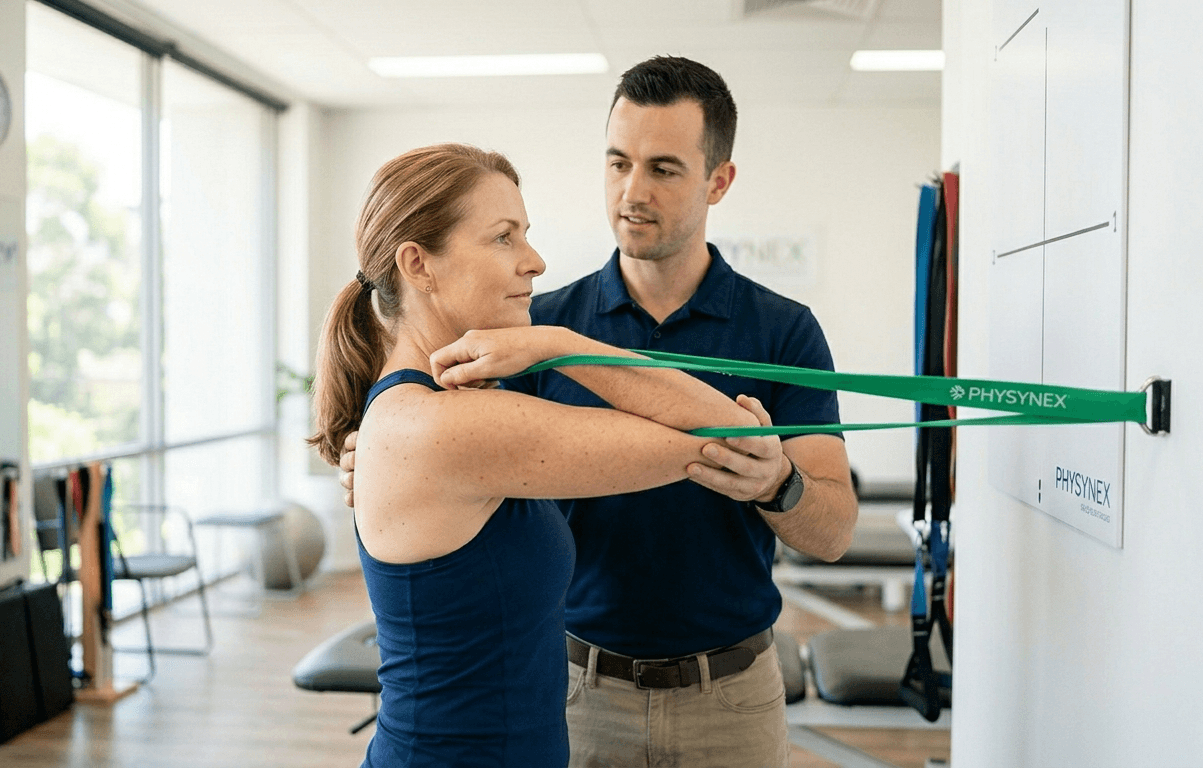

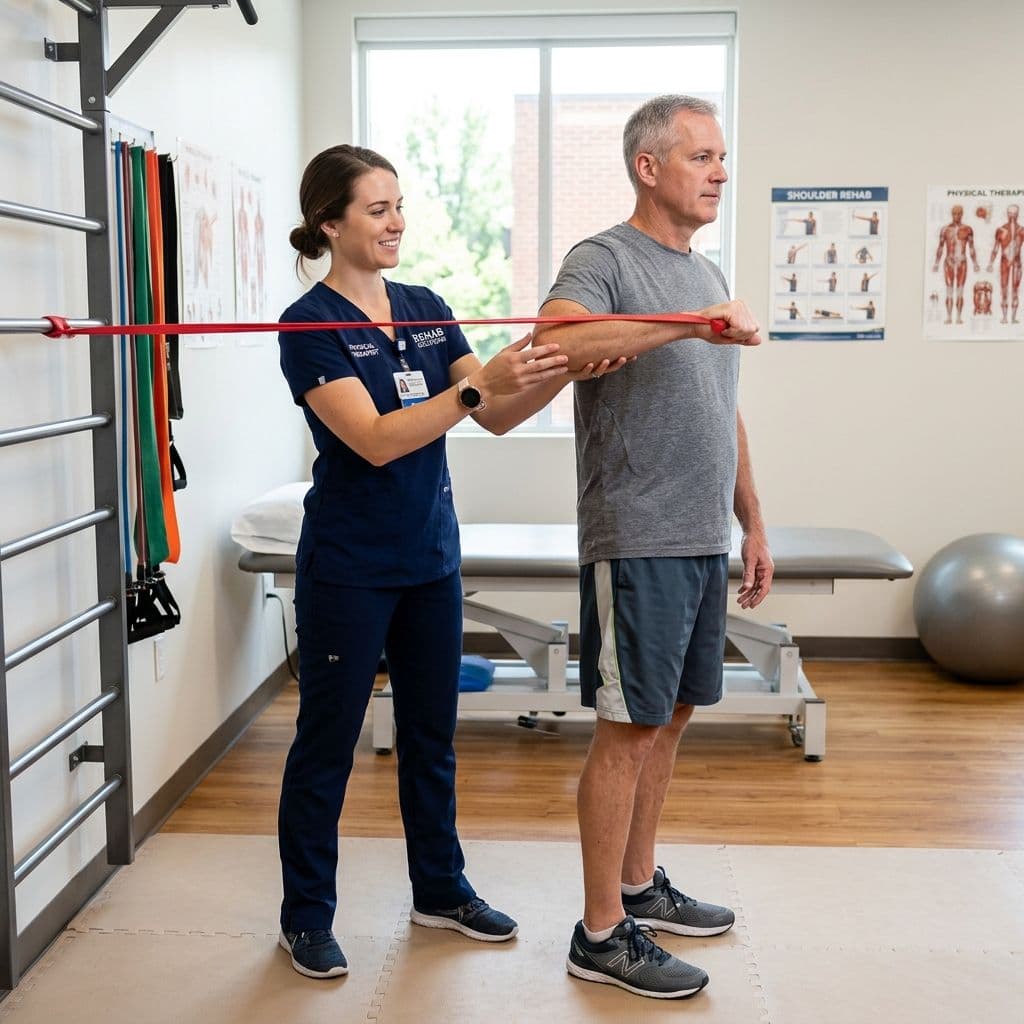
Frozen shoulder can be frustrating because the shoulder becomes painful and stiff even when there has been no obvious injury. Reaching overhead, fastening clothing, sleeping on the affected side, or placing the hand behind the back can become difficult. People are often told simply to stretch harder, yet aggressive stretching during an irritable stage can make symptoms worse.
The condition is also known as adhesive capsulitis. It typically involves a gradual loss of both active movement and movement when someone else gently moves the shoulder. Recovery often takes months rather than weeks, and the pace varies considerably. Diabetes, thyroid disease, recent surgery, and prolonged shoulder immobilisation are associated with higher risk.
A timeline is useful only when it sets expectations without becoming a promise. Physiotherapy should respond to the current stage, pain irritability, sleep, function, and movement rather than forcing every patient through an identical calendar.
How frozen shoulder differs from other shoulder pain
Rotator cuff-related pain may make lifting painful, but passive movement can remain relatively available. Frozen shoulder usually produces a more global restriction, with external rotation often notably limited. Arthritis can also cause stiffness, so age, history, imaging when indicated, and the full examination matter.
Diagnosis should not be based on one painful reach. A clinician considers the gradual onset, night pain, movement pattern, strength, neck symptoms, trauma history, and medical conditions. Sudden weakness after injury or a visibly altered shoulder requires a different pathway.
- Progressive stiffness in several directions
- Difficulty with both self-movement and assisted movement
- Night pain and trouble lying on the affected side
- Marked limitation reaching behind the back or rotating outward
- No single exercise or massage response that immediately restores motion
The painful or freezing stage
Early in the condition, pain may be more limiting than stiffness. The shoulder can react strongly to stretching and remain sore for hours. The priority is to preserve comfortable movement, support sleep, maintain use of the arm within tolerance, and avoid repeatedly provoking long flares.
Gentle assisted movement, pendulum-type motion, and low-load activation may be appropriate. Heat or other symptom-relief strategies can be discussed, and medication questions should be directed to the appropriate medical professional. Manual therapy may help comfort but should not be forceful.
- Use shorter, gentler mobility sessions rather than one aggressive stretch
- Keep the elbow, wrist, and hand moving normally
- Support the arm during sleep if that improves comfort
- Avoid repeated end-range forcing that causes a prolonged flare
- Monitor pain, sleep, and daily function as well as range
The stiff or frozen stage
As resting pain becomes less dominant, stiffness may be the main limitation. This is often the stage when mobility work can be progressed more deliberately. The clinician may use joint mobilisation, assisted range exercises, and strengthening within the available range.
Strength is important because months of guarded use can reduce shoulder and upper-back capacity. Exercises may begin below shoulder height and gradually move into larger ranges. The dose should create a manageable response, not a contest to regain motion in one session.
- Progress assisted flexion and external rotation gradually
- Add shoulder-blade, rotator cuff, and arm strengthening
- Practise grooming, dressing, reaching, and other meaningful tasks
- Use objective range and function measures to track change
- Review whether progress has stalled or the diagnosis needs reconsideration
The thawing or recovery stage
Movement often improves more noticeably during the later stage, although the rate remains variable. Rehabilitation should shift toward strength through the regained range and tasks that have remained restricted. Simply achieving a larger passive range is not enough if the arm still lacks control or confidence.
Work, sport, and household activities may require endurance and load beyond basic mobility. A person returning to swimming, lifting, or overhead work needs a more demanding final phase than someone whose main goal is comfortable dressing and sleep.
- Build strength at progressively higher angles
- Restore control during lowering as well as lifting
- Reintroduce overhead load in small steps
- Continue mobility only where meaningful restriction remains
- Use task-specific milestones before discharge
Why recovery dates vary so much
Frozen shoulder may take a year or longer to fully settle, although meaningful functional gains can occur earlier. Timelines are affected by stage at presentation, diabetes, irritability, sleep, previous surgery, exercise response, and how the condition is defined.
A slow timeline does not justify months of identical treatment. The plan should change when pain settles, range improves, or a plateau appears. If progress is unexpectedly limited, the clinician may discuss medical review or other treatment options.
Common frozen shoulder mistakes
The first mistake is forcing the shoulder through severe pain because stiffness feels like something that must be broken. This can increase guarding and reduce confidence. The second is avoiding the arm completely, which can increase deconditioning and make daily tasks harder.
Another mistake is treating every shoulder stiffness as frozen shoulder. Rotator cuff injury, arthritis, neck-related pain, and post-surgical restriction require different decisions. Reassessment matters when the symptom pattern changes.
- Using aggressive stretches during a highly irritable stage
- Comparing progress with someone at a different stage
- Focusing only on range and ignoring strength or function
- Stopping all arm use because movement is uncomfortable
- Continuing an unchanged plan despite no measurable progress
Protect sleep and daily function while the shoulder recovers
Night pain can become the most exhausting part of frozen shoulder. Experiment with a pillow supporting the forearm, a more upright position, or sleeping on the unaffected side with the painful arm supported in front. A position that works for one person may not suit another, so comfort rather than a rigid sleep rule should guide the choice.
Daily tasks can be adapted without abandoning the arm. Move frequently used items to an accessible height, dress the affected arm first and undress it last when helpful, and use both hands for heavier objects. These are temporary strategies that preserve independence while the rehabilitation plan gradually restores range and strength.
Track meaningful function alongside shoulder angles. Reaching a shelf, washing hair, fastening clothing, lying comfortably, and carrying an object often improve at different rates. A functional record prevents one stubborn movement from making the entire recovery appear unsuccessful and helps the clinician decide when to change the exercise emphasis.
- Support the arm during sleep when it reduces pulling
- Adapt dressing and grooming rather than forcing painful ranges
- Keep light, tolerable use of the arm through the day
- Track two or three personally important tasks
- Review pain management medically when sleep remains severely disrupted
Red flags: when symptoms need urgent medical review
Frozen shoulder develops gradually. Sudden severe symptoms, major trauma, systemic illness, or neurological changes should not be automatically attributed to adhesive capsulitis.
- Shoulder deformity or inability to move the arm after significant trauma
- A hot, red, markedly swollen joint with fever
- Sudden loss of strength after a fall or forceful injury
- New chest pain, breathlessness, sweating, or pain spreading from the chest
- Progressive arm numbness, hand weakness, or severe neck-related symptoms
Questions patients commonly ask
These answers are general guidance. The right decision depends on your symptoms, medical history, examination findings, and the activities you need to return to.
Can frozen shoulder be cured quickly?
There is no reliable instant cure. Treatment aims to manage pain, preserve or restore movement, maintain strength, and improve function while the condition evolves. Some medical interventions may be considered depending on stage and severity.
Should frozen shoulder exercises hurt?
Mild discomfort can occur, but severe pain or a prolonged flare suggests the dose is too high. The acceptable response depends on the stage. Exercise should be adjusted using both the immediate response and how the shoulder feels later.
Is a steroid injection always required?
No. It may be discussed for selected patients, particularly when pain is highly limiting, but suitability depends on medical history, stage, risks, and clinical findings. The decision should be made with an appropriately qualified clinician.
Can frozen shoulder return?
Recurrence in the same shoulder is not common, but the other shoulder can be affected. New stiffness still deserves assessment rather than assuming it is the same condition.
The clinic takeaway for frozen shoulder recovery
Frozen shoulder rehabilitation should change with the condition. Early care respects irritability, middle-stage care restores movement and strength, and later care rebuilds the tasks that matter. An honest timeline is measured in milestones, not guaranteed weeks.
At Physynex, bring details of when stiffness began, relevant medical conditions, previous surgery or injury, and the daily tasks most affected. That helps the clinician confirm the likely pattern and choose a dose that challenges the shoulder without repeatedly overwhelming it.
Relevant Physynex care pathways
Use these pages to understand the related condition or service. An assessment is still the right starting point when the diagnosis is uncertain.