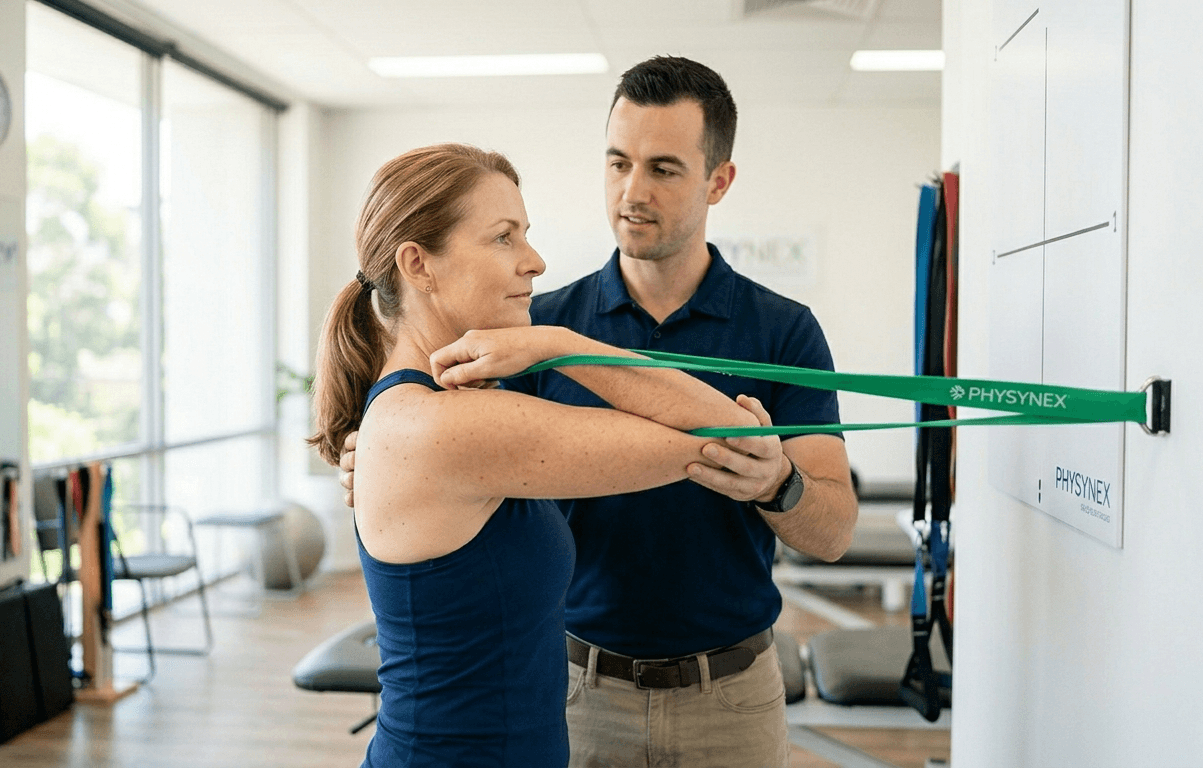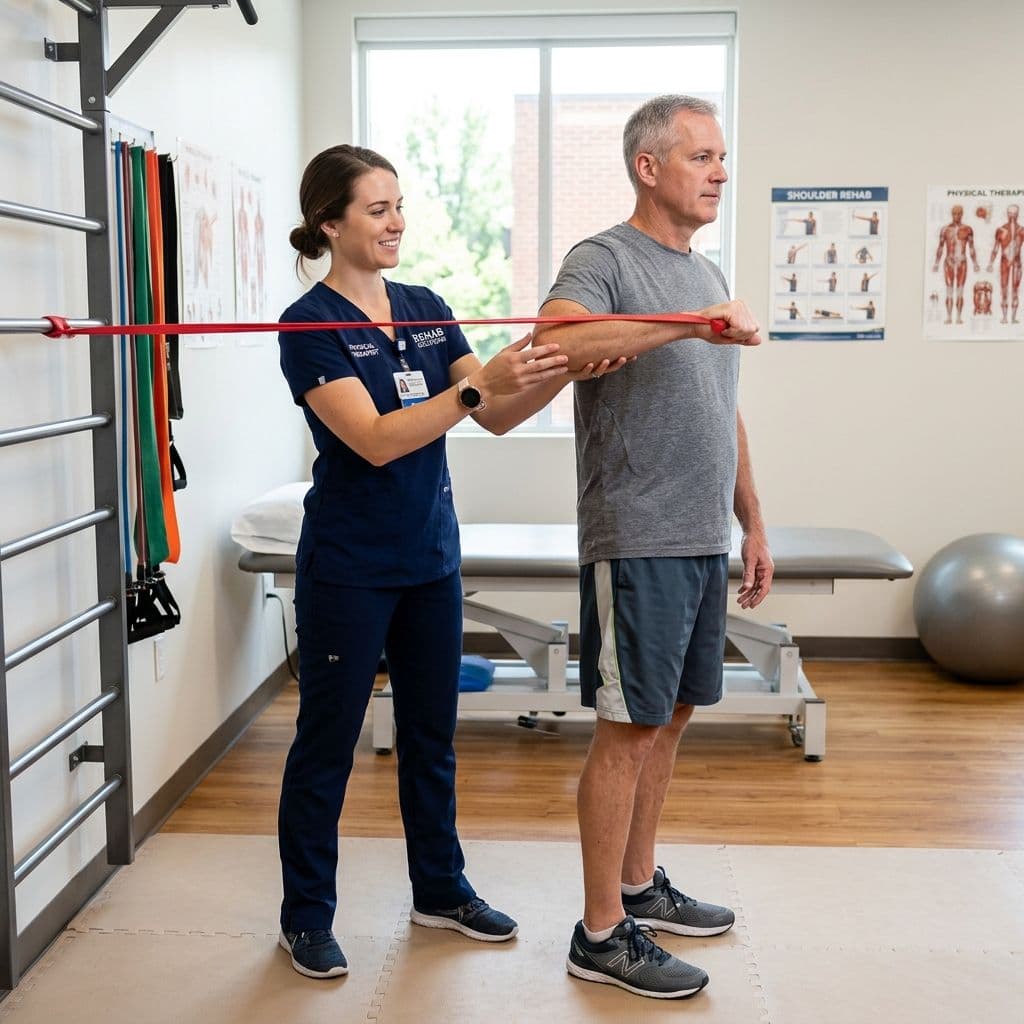

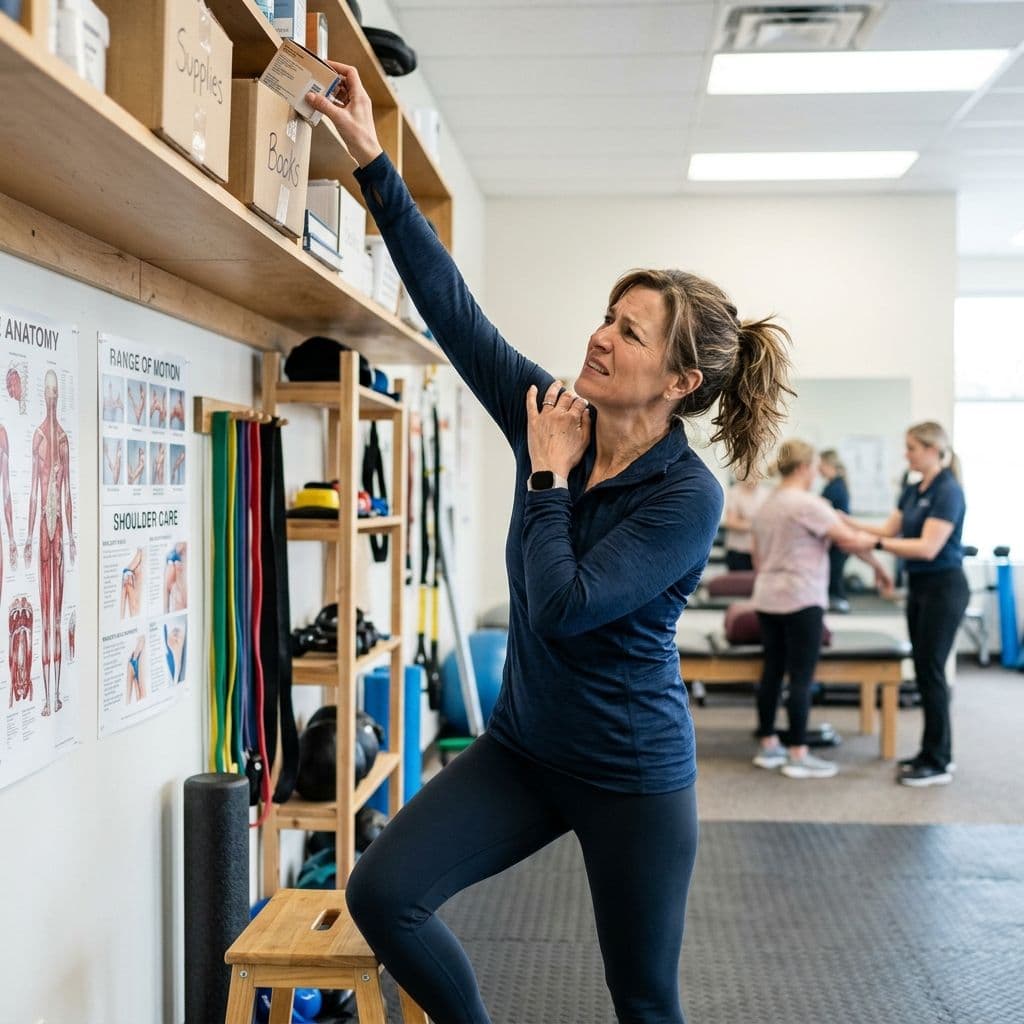
Pain when lifting the arm is often described as a rotator cuff injury, but the same complaint can occur with frozen shoulder, arthritis, neck-related pain, or several other conditions. The exact painful angle is less important than the whole pattern: how movement is limited, whether someone else can move the arm farther, how strength behaves, and whether the onset followed trauma.
Rotator cuff-related shoulder pain commonly hurts during active lifting, reaching, or lowering. Frozen shoulder tends to create broader stiffness, including when the arm is moved passively. These are useful distinctions, not home diagnostic tests.
An accurate assessment prevents two opposite mistakes: forcing a highly irritable frozen shoulder as though it only needs strength, or protecting a load-sensitive rotator cuff indefinitely when gradual strengthening is needed.
Features that may fit rotator cuff-related pain
The rotator cuff helps centre and control the shoulder during arm movement. Symptoms may develop after a training increase, repeated overhead work, or gradually without one clear injury. Pain is often felt over the outer upper arm and can be worse when reaching overhead, behind the body, or lowering a load.
Movement may be painful but not globally restricted. Assisted or passive movement can be better than active lifting. Strength testing may reproduce pain, although pain-limited weakness differs from a sudden inability to lift after trauma.
- Pain with active lifting or lowering
- Discomfort when lying on the affected side
- Pain during resisted shoulder movements
- Relatively better passive than active movement
- Symptoms linked to changes in overhead load
Features that may fit frozen shoulder
Frozen shoulder usually develops with progressive pain and stiffness. Several directions become limited, often including external rotation and reaching behind the back. The restriction is present during self-movement and when the clinician gently moves the relaxed arm.
Night pain can be substantial in the earlier stage. Diabetes, thyroid conditions, recent surgery, and immobilisation are relevant associations. Because arthritis can also cause stiffness, diagnosis still requires the broader history and examination.
- Gradual global loss of shoulder movement
- Passive movement restricted as well as active movement
- Difficulty with grooming, dressing, and reaching behind the back
- Night pain with increasing stiffness
- A course that evolves over months rather than one workout
What the shoulder assessment should include
The clinician compares active and passive movement, assesses strength, asks about trauma, and screens the neck and neurological system when needed. Age, health conditions, occupation, sport, sleep, and the activities that have become difficult all influence reasoning.
Imaging is not automatically needed. It may be useful after significant trauma, when marked weakness suggests a substantial tear, when arthritis is suspected, or when findings would change treatment. Scan abnormalities become more common with age and must be matched to symptoms.
- Active and passive range in several directions
- Rotator cuff and shoulder-blade strength
- Neck movement, sensation, and nerve-related symptoms
- Trauma, dislocation, surgery, and medical history
- Functional tasks such as reaching, dressing, and lifting
Why the treatment plans differ
Rotator cuff-related pain often responds to load modification and progressive strengthening. Early exercises may use tolerable isometric or short-range work, then progress to rows, external rotation, presses, raises, carries, and overhead tasks. Restoring capacity is more useful than permanently avoiding painful angles.
Frozen shoulder treatment changes by stage. During a painful, irritable phase, forceful stretching may worsen symptoms. Gentle movement and comfort strategies are emphasised. As irritability falls, mobility and strength can be progressed more assertively.
- Match exercise to irritability rather than diagnosis name alone
- Build rotator cuff load gradually when strength is the priority
- Respect global stiffness and stage during frozen shoulder
- Train meaningful reaching and lifting as symptoms allow
- Review progress objectively instead of repeating the same session
What if both pain and stiffness are present?
Pain commonly creates temporary guarding, so a sore rotator cuff can look stiff. The clinician examines the pattern, end feel, passive range, and change over time. Treatment can address both comfort and strength while the diagnosis becomes clearer.
A label should not delay useful care. The plan can be adjusted as the shoulder’s response reveals whether the main limitation is irritability, true capsular stiffness, weakness, or another condition.
Common mistakes with painful shoulder elevation
Avoiding the arm completely can reduce strength and confidence, while repeatedly forcing a painful range can keep the shoulder irritated. A graded approach preserves movement and introduces load at a level the shoulder can recover from.
Another mistake is assuming every scan finding explains the pain. Treatment decisions should reflect function, examination, symptoms, and goals, not the report alone.
- Diagnosing a tear from pain alone
- Stretching a highly irritable frozen shoulder aggressively
- Using only massage without restoring load tolerance
- Returning to heavy overhead work after one good day
- Ignoring neck symptoms or neurological changes
Use daily tasks to clarify the pattern and guide progression
Observe which type of task is hardest. A rotator cuff-related presentation may struggle with lifting or lowering a weighted object while assisted range remains reasonable. Frozen shoulder may restrict an unloaded reach, dressing, or external rotation even when the person tries to relax. This difference helps the clinician select the initial emphasis.
Choose two repeatable tasks as outcome measures: reaching a particular shelf, placing the hand behind the head, lifting a known object, or fastening clothing. Retest them periodically, not several times per day. Frequent testing can irritate the shoulder and makes normal variation feel like failure.
Progress load and range separately. A person may first strengthen below shoulder height, then increase elevation without weight, and later combine overhead range with resistance. A frozen shoulder may gain range before it can control a heavy object. Task-based progression respects these differences while keeping treatment connected to real function.
- Compare unloaded movement with loaded movement
- Select repeatable daily tasks as outcome measures
- Avoid testing the most painful reach throughout the day
- Progress range before load when the shoulder requires it
- Reassess when weakness or stiffness changes unexpectedly
Red flags: when symptoms need urgent medical review
Arrange urgent assessment when shoulder symptoms follow major trauma, include systemic illness, or are accompanied by chest or neurological signs.
- Visible deformity or inability to move the arm after trauma
- A hot, red, swollen shoulder with fever
- Sudden marked weakness after a fall or forceful injury
- Chest pain, breathlessness, sweating, or pain spreading from the chest
- Progressive arm numbness, hand weakness, or severe neck symptoms
Questions patients commonly ask
These answers are general guidance. The right decision depends on your symptoms, medical history, examination findings, and the activities you need to return to.
Can I test for a rotator cuff tear at home?
Home tests are not reliable enough to confirm or exclude a tear. Pain can inhibit strength, and several shoulder conditions overlap. Significant trauma or sudden loss of function deserves clinical assessment.
Should I stop all overhead movement?
Temporary modification may help an irritable shoulder, but permanent avoidance can reduce capacity. The range, load, and volume can be graded according to the diagnosis and response.
Does frozen shoulder always need an injection?
No. Injections may be discussed for selected patients, particularly when pain is limiting rehabilitation, but stage, medical history, risks, and patient preference matter.
How long does rotator cuff rehabilitation take?
It depends on duration, severity, strength loss, goals, health, and load demand. Progress should be visible in function and strength over time even when complete symptom resolution takes longer.
The clinic takeaway when raising the arm hurts
Rotator cuff-related pain and frozen shoulder overlap, but they do not require identical treatment. Comparing active and passive movement, strength, irritability, trauma history, and medical factors helps identify the dominant pattern.
At Physynex, explain whether the shoulder feels weak, stiff, painful, or all three, and identify the exact tasks you have lost. The assessment can then select the right balance of mobility, strength, symptom management, and medical referral.
Relevant Physynex care pathways
Use these pages to understand the related condition or service. An assessment is still the right starting point when the diagnosis is uncertain.