
Stairs place a higher demand on the knee than level walking. The thigh and hip muscles must control body weight as the knee bends, and the kneecap joint experiences greater load. That is why a knee that feels acceptable on flat ground may hurt when climbing, descending, squatting, or getting up from a low chair.
The location and behaviour of pain provide useful clues. Discomfort around or behind the kneecap commonly fits a patellofemoral pattern. Pain with stiffness and reduced movement may occur with osteoarthritis. A tender tendon, recent training increase, swelling, locking, or a twisting injury creates a different clinical picture.
This article cannot diagnose the cause from one symptom. It explains how a physiotherapist reasons through the possibilities, how exercise is progressed, and which signs should prompt medical review.
Common reasons stairs provoke knee pain
Patellofemoral pain is a broad term for pain around the kneecap that is influenced by load. It can be associated with a sudden increase in running, repeated stairs, long sitting, reduced hip or thigh capacity, or a return to activity after a break. The kneecap is not necessarily “out of place”; the joint may simply be receiving more demand than it is ready for.
Osteoarthritis can also make stairs difficult, especially when there is morning stiffness, reduced bend, swelling, or pain during several weight-bearing tasks. Tendon pain is often more local and load-dependent. Meniscal or ligament injuries become more likely when symptoms follow a twist, impact, or rapid change of direction.
- Pain around the kneecap during stairs, squats, or prolonged sitting
- Joint stiffness and reduced movement associated with arthritis
- Local tendon pain after a jump in training volume
- Swelling or mechanical symptoms after a twisting injury
- Reduced hip, thigh, or calf capacity increasing demand on the knee
What the knee assessment should include
A useful assessment starts with the story: where pain is felt, when it began, whether the knee swells, and whether there was trauma. The clinician should ask about locking, giving way, night pain, previous injury, current exercise, work demands, and the number of stairs encountered daily.
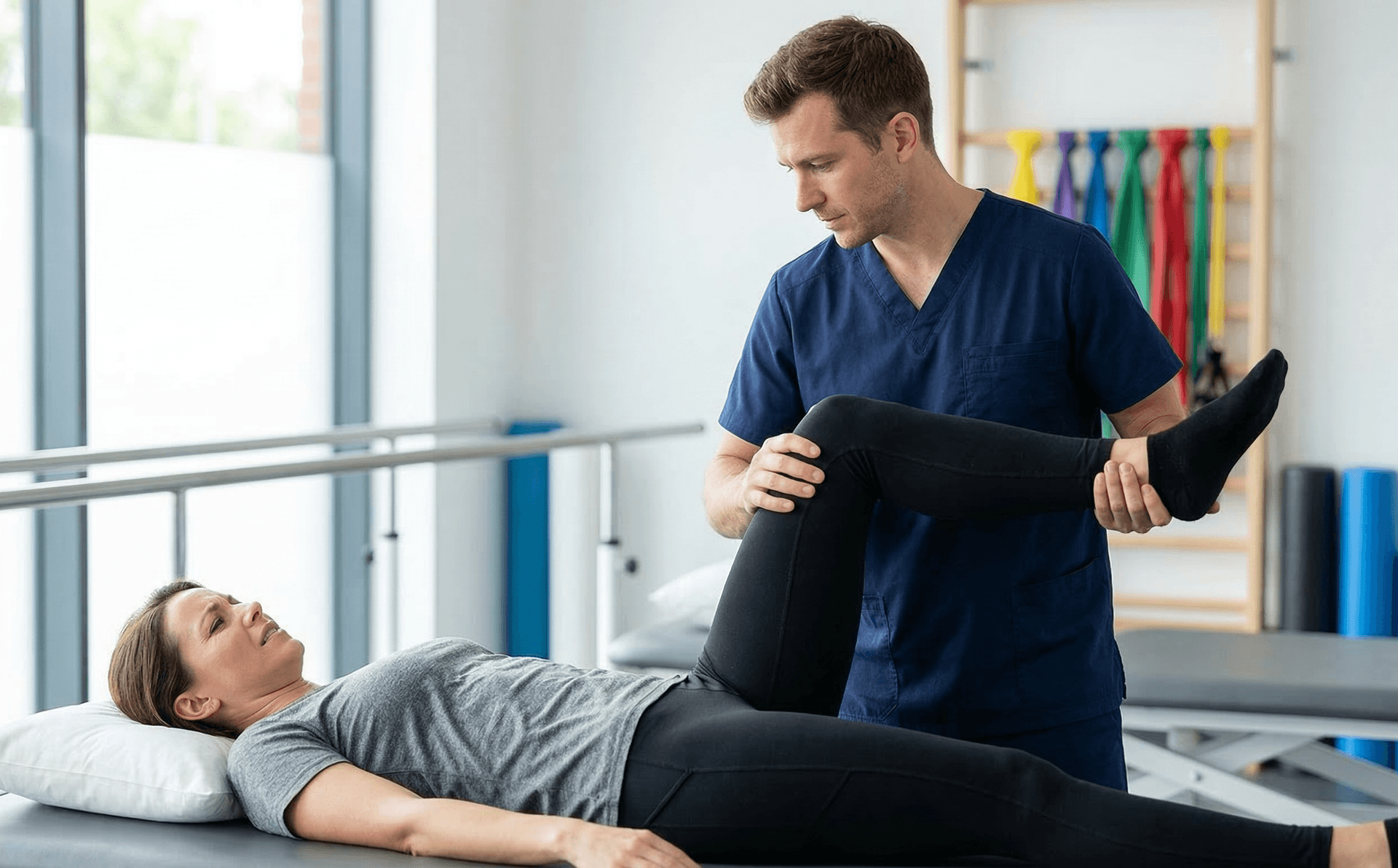
The physical examination may compare knee movement, swelling, tenderness, strength, balance, and control during a squat, step-up, step-down, or sit-to-stand. Hip and ankle function matter because stairs are a whole-limb task. Special tests can support clinical reasoning, but no single test should be interpreted in isolation.
- Knee bend and straightening compared with the other side
- Swelling, warmth, tenderness, and joint irritability
- Quadriceps, hip, hamstring, and calf strength
- Step and squat technique at different heights
- Training changes, footwear, body-weight goals, and recovery
How physiotherapy reduces stair-related knee pain
Rehabilitation usually begins by adjusting the amount of knee load rather than removing it completely. Temporarily using a lower step, reducing repeated deep squats, or spacing stair trips may calm an irritable knee. That reduction should be paired with exercise so tolerance improves instead of remaining permanently restricted.
Strength work commonly targets the quadriceps and hips, but the best exercise depends on current tolerance. A shallow sit-to-stand may be an entry point; later stages can use split squats, step-downs, heavier squats, or gym machines. Calf strength and balance may also improve lower-limb control.
- Choose a step height that allows controlled practice
- Build thigh strength through a tolerable range
- Train hip and calf muscles to share lower-limb demand
- Increase repetitions or resistance gradually, not both at once
- Practise the exact stair task as capacity improves
What to do during a temporary flare
A flare does not always mean the exercise has caused damage. Review whether the recent increase was too large, reduce the dose for several days, and keep comfortable movement. Swelling, sharp mechanical symptoms, or a clear loss of function need reassessment.
Track the response later that day and the next morning. This is more informative than judging an exercise from the first repetition alone. The program should be challenging enough to create adaptation without repeatedly provoking a prolonged setback.
Technique tips that can make stairs more manageable
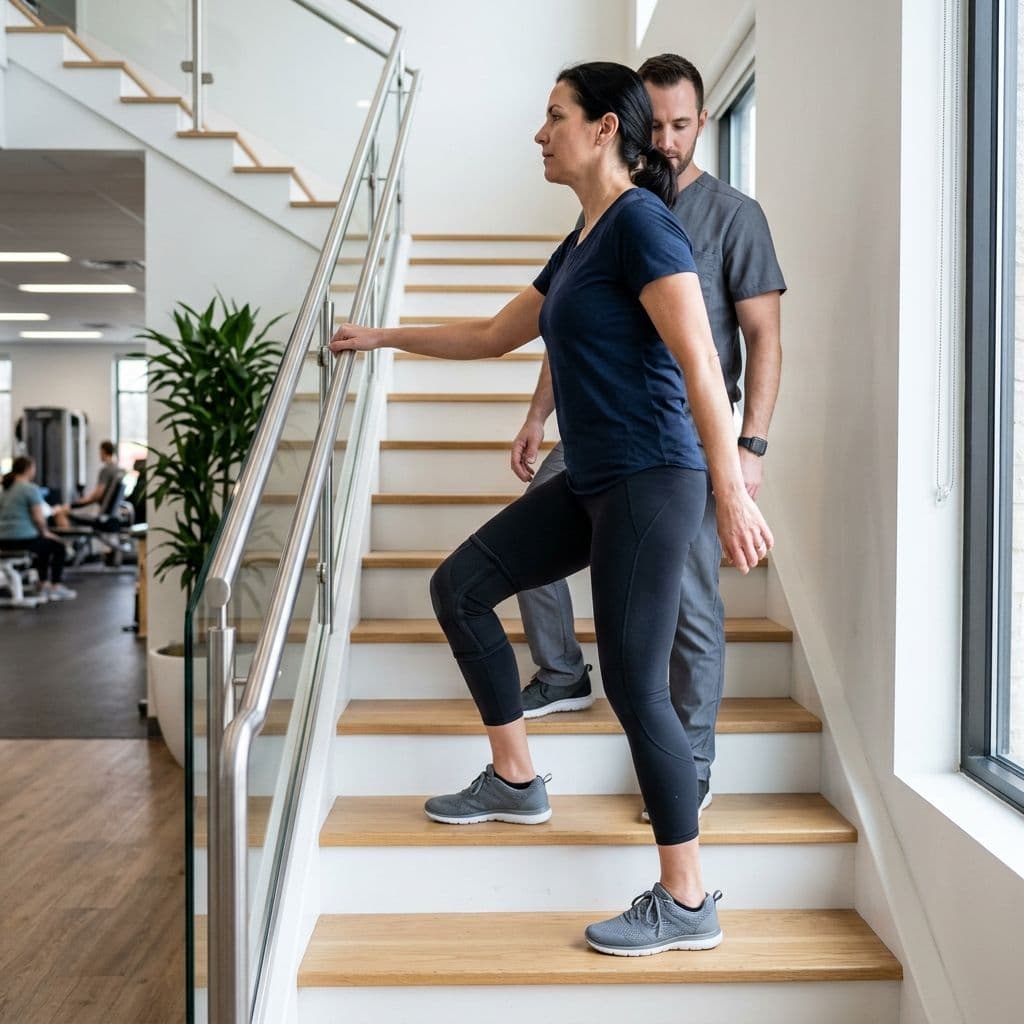
Technique is a temporary tool, not a permanent rule. Using the handrail, leaning the trunk slightly forward, or placing more of the foot on the step can reduce demand while strength is rebuilding. Descending often feels harder because the thigh muscles must control lowering.
If one knee is very irritable, a clinician may teach a step-to pattern for short-term safety. The long-term aim is usually to restore a normal alternating pattern when appropriate. Avoid turning every stair into a movement test; confidence improves through repeated successful practice.
- Use the rail when pain or balance affects control
- Place the whole foot securely on the step
- Slow the lowering phase instead of dropping onto the next step
- Reduce unnecessary stair volume temporarily during a flare
- Progress toward normal stair use as strength and confidence return
Mistakes that delay knee recovery
Resting until the knee feels perfect can reduce fitness and strength, making stairs feel even harder when activity resumes. At the other extreme, repeatedly testing painful stairs or deep squats can keep an irritable joint overloaded. Rehabilitation requires a middle path: enough load to build capacity and enough recovery to adapt.
Another common mistake is choosing exercises only because they are labelled “knee exercises.” The dose, range, resistance, and technique must suit the person. A program should evolve as symptoms and strength change.
- Stopping all leg exercise for several weeks without a plan
- Ignoring persistent swelling or locking
- Progressing step height before movement is controlled
- Changing the program constantly instead of measuring response
- Assuming every grinding or clicking sound means joint damage
How to progress from exercise to confident stair use
A rehabilitation exercise becomes useful when it transfers to the stair task. Begin with a height and support level that permit control. A low step-up may be easier than descending because lowering demands more eccentric quadriceps control. The handrail can be used while strength is developing rather than treated as failure.
Progress one variable at a time. Increase repetitions before adding height, or add resistance while keeping the step unchanged. Later, practise different staircases, carrying a light object, and completing several flights with rest as needed. The aim is to prepare for the stairs at home, work, transport, or sport rather than only performing a clinic drill.
Measure the knee’s response across the day. Mild effort during exercise can be reasonable, but increasing swelling, a worsening limp, or pain that remains substantially higher the next morning suggests the dose needs adjustment. Strength should also be measured because symptom improvement can occur before the thigh has regained enough capacity for repeated stairs.
- Start with a low step and stable support
- Train controlled lowering as a separate skill
- Progress height, resistance, and volume separately
- Practise the number of flights required in daily life
- Reassess swelling, range, and strength when progress stalls
Red flags: when symptoms need urgent medical review
Arrange prompt medical assessment when knee pain follows significant trauma or when the joint shows signs that are not typical of routine overload.
- Inability to bear weight after an injury
- A visibly deformed knee or rapidly increasing swelling
- A hot, red, very swollen joint with fever or feeling unwell
- True locking where the knee cannot bend or straighten
- New calf swelling, chest pain, or shortness of breath
Questions patients commonly ask
These answers are general guidance. The right decision depends on your symptoms, medical history, examination findings, and the activities you need to return to.
Does knee clicking mean I should stop using stairs?
Clicking without pain or swelling is common and does not automatically indicate damage. Painful clicking after injury, locking, or repeated giving way deserves assessment. Function and symptom behaviour matter more than sound alone.
Are squats bad for kneecap pain?
Squats are a load, not inherently a problem. Depth, resistance, volume, and technique can be modified. A shallow supported squat may be appropriate early, while deeper or heavier versions can be introduced when tolerance improves.
Should I use a knee brace?
Some people find short-term support helpful, but a brace is not a substitute for assessment and strengthening. The type and purpose should be clear, particularly after injury or when instability is suspected.
Can arthritis improve even if the scan does not change?
Yes. Pain, strength, walking, and stair function can improve without reversing structural findings on an X-ray. Rehabilitation focuses on what the joint and the person can do, while medical care addresses other factors when needed.
The clinic takeaway when stairs hurt
Stair pain is a useful clue, not a diagnosis. The solution depends on whether the main issue is kneecap load, arthritis, tendon capacity, injury, or another condition. Good physiotherapy measures the task, adjusts current load, and progressively restores the strength and control needed for it.
At Physynex, note whether climbing or descending is worse, where the pain sits, whether swelling occurs, and what changed before symptoms began. Those details make the assessment more precise and help set meaningful milestones.
Relevant Physynex care pathways
Use these pages to understand the related condition or service. An assessment is still the right starting point when the diagnosis is uncertain.