
Section Guide
6 Sections

Targeted rehabilitation for calf strains, calf tightness, push-off pain, and return-to-walk or return-to-run recovery.
Section Guide
6 Sections
This section explains how symptoms typically behave, what often keeps them going, and which physical capacities usually need to improve for recovery to hold up in daily life.
Calf pain often starts after sprinting, sudden acceleration, jumping, hill walking, or a rapid increase in training load. Some people notice a sudden pull, while others develop recurring tightness that never fully settles.
The calf complex plays a major role in walking, stairs, push-off, and running speed. If strength, ankle mobility, and loading tolerance are not restored properly, symptoms often return when activity picks up again.
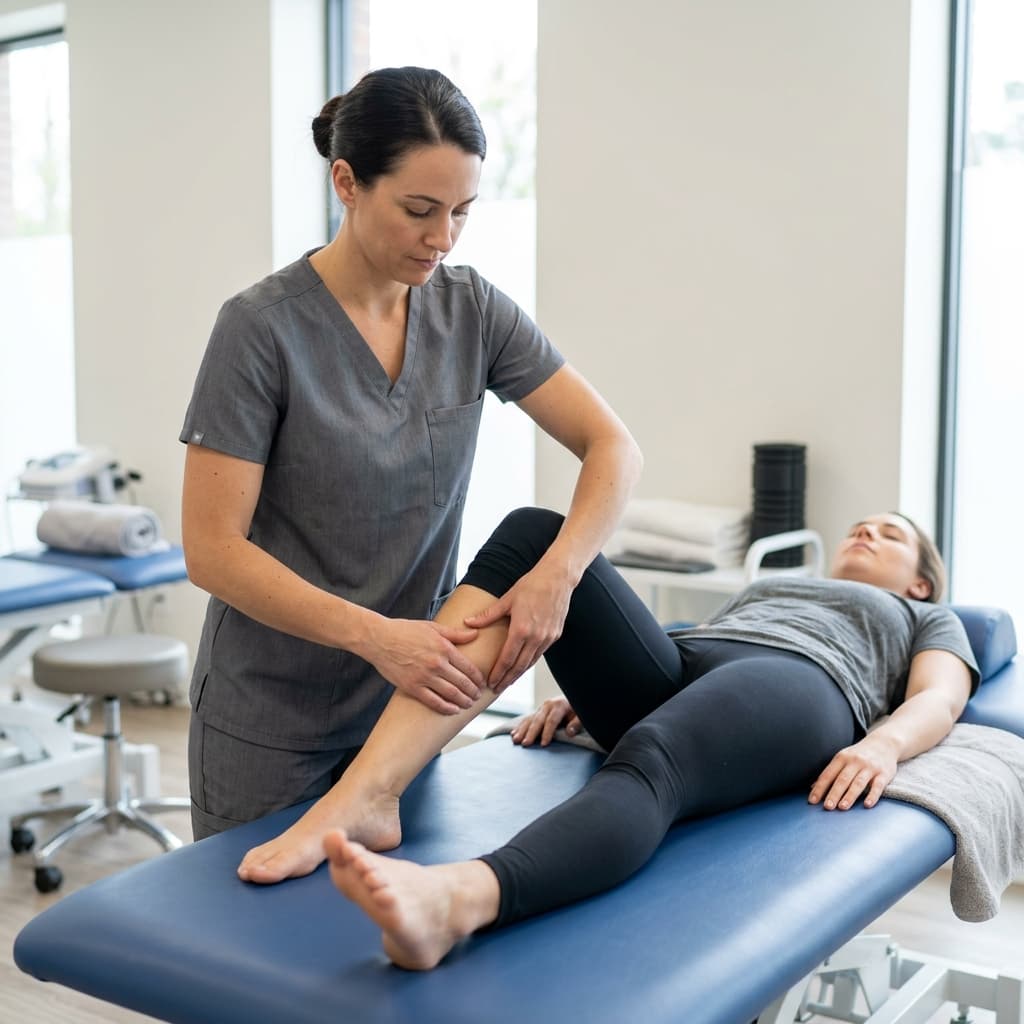
Structured physiotherapy helps calm the area early, then rebuilds calf capacity so you can return to normal walking, gym work, and running with better confidence.

Clinical Snapshot
Targeted rehabilitation for calf strains, calf tightness, push-off pain, and return-to-walk or return-to-run recovery.
Typical Symptom Pattern
What We Clarify During Assessment
Related Guides
If your symptoms feel more specific or overlap with another pattern, these guides can help you understand the closest condition pathways.
Foot and Ankle Pain
Targeted physiotherapy for ankle sprains, plantar heel pain, Achilles overload, calf strain, and lower-limb movement dysfunction.
Muscle Strain Recovery
Sport-specific rehabilitation for acute muscle strains, recurring pulls, and return-to-play progression with clear loading milestones.
Knee Pain
Evidence-based rehabilitation for patellofemoral pain, meniscal irritation, ligament recovery, arthritis-related stiffness, and load-related knee pain.
We first work out whether your symptoms behave like an acute strain, a recurring overload problem, or a mixed calf-Achilles issue. That lets us match early loading and pain reduction more accurately instead of resting the area for too long or pushing it too early.
Once the calf settles, rehab shifts toward strength, endurance, and push-off confidence. Later stages rebuild your tolerance for stairs, faster walking, jogging, and sport-specific demands so the area is ready for real life again.
Your Plan May Include
Usually yes, within tolerable limits. The goal is to manage load sensibly while protecting the calf from a bigger flare-up, not to stop all movement unless walking is severely affected.
Return to running depends on pain response, calf strength, push-off confidence, and tolerance to staged loading. It is usually based on milestones rather than a fixed number of days.
No. Calf symptoms can come from strain, overload, stiffness, or linked Achilles irritation. A proper assessment helps decide what type of rehab is needed.